
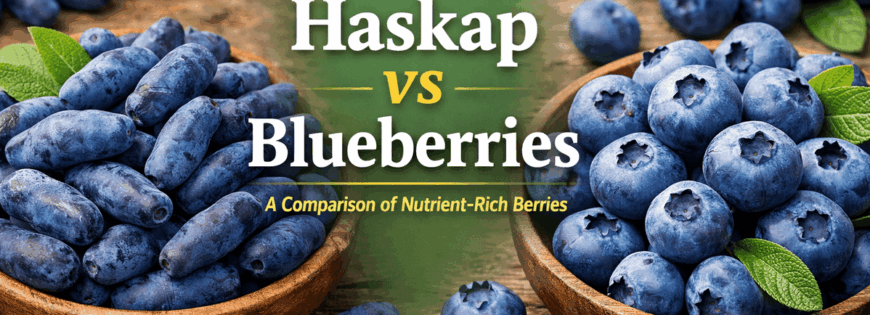
When it comes to cultivating nutrient-dense, high-yielding berry plants, gardeners often compare Haskap berries and Blueberries. Both fruits are celebrated for their exceptional flavour, antioxidant power, and versatility, yet they differ significantly in growth habits, climate adaptability, soil requirements, harvesting cycles, and nutritional profiles. Understanding these differences allows us to make informed planting decisions and maximize both garden productivity and fruit quality.
Origin and Botanical Background
Haskap berries, also known as Honeyberries, originate from the cold regions of Japan, Russia, and Northern Europe. They belong to the Lonicera caerulea species and are closely related to edible honeysuckle. Their natural resilience makes them particularly suited for harsh winters and shorter growing seasons.
Blueberries, on the other hand, belong to the Vaccinium genus and are native to North America. They have been cultivated extensively for centuries and are available in multiple varieties such as Highbush, Lowbush, and Rabbiteye. Their popularity stems from their sweet flavour and adaptability to moderate climates.
Climate Adaptability and Hardiness
One of the most striking distinctions lies in temperature tolerance.
- Haskap plants thrive in extremely cold climates, surviving temperatures as low as -40°C (-40°F). They bloom early in spring and are less vulnerable to frost damage.
- Blueberries prefer moderate climates and require winter chilling hours but are not as tolerant of severe cold. Some varieties struggle in regions with harsh winters.
For gardeners in northern or mountainous regions, haskap berries provide a reliable and resilient option, whereas blueberries perform best in temperate zones with well-defined seasonal cycles.
Soil Requirements and pH Preferences
Soil compatibility plays a crucial role in successful berry cultivation.
- Haskap berries are highly adaptable and grow well in neutral to slightly acidic soil with a pH range of 5.5 to 7.0.
- Blueberries demand strongly acidic soil, ideally between 4.5 and 5.5. Without this acidity, nutrient uptake becomes inefficient, leading to poor yields.
This difference makes haskaps far easier to grow for beginner gardeners, as they require less soil amendment and maintenance compared to blueberries, which often need peat moss, sulfur treatments, or acidic fertilizers.
Growth Habit and Plant Structure
Haskap shrubs grow upright and compact, typically reaching 4–6 feet in height. Their shape allows for dense planting and efficient space utilization. They are also known for minimal pruning requirements.
Blueberry bushes vary widely depending on the variety. Highbush blueberries can grow up to 8 feet tall, while lowbush varieties remain under 2 feet. Blueberries often need regular pruning to maintain productivity and airflow.
Gardeners seeking low-maintenance fruit shrubs often gravitate toward haskaps, whereas blueberries demand ongoing shaping and care.
Blooming and Harvesting Timeline
Timing significantly affects productivity.
- Haskap berries bloom earlier and are typically harvested late spring to early summer, often weeks before strawberries.
- Blueberries ripen later, usually from mid-summer to early autumn, depending on the cultivar.
This early harvest gives haskaps a strategic advantage for gardeners who want continuous fruit supply throughout the season by planting both varieties.
Taste and Flavour Profile
Flavour preferences often determine planting choices.
- Haskap berries offer a unique taste described as a blend of blueberry, raspberry, and black currant, with a subtle tartness.
- Blueberries deliver a sweeter, milder flavour, making them widely appealing and ideal for fresh consumption.
Haskaps excel in jams, wines, smoothies, and desserts, while blueberries remain a universal favourite for snacking and baking.
Nutritional Value and Antioxidant Strength
Both berries are nutritional powerhouses, but haskaps hold a notable edge.
- Haskap berries contain exceptionally high levels of anthocyanins, vitamin C, and polyphenols.
- Blueberries are rich in antioxidants, fiber, and essential vitamins but generally contain slightly lower anthocyanin concentration compared to haskaps.
For gardeners focused on functional foods and health benefits, haskaps provide superior antioxidant density.
Yield and Productivity
Productivity determines long-term value.
- Haskap shrubs mature quickly and can begin producing fruit within 2–3 years, offering consistent high yields with minimal intervention.
- Blueberries may take longer to establish, often requiring 3–5 years before reaching peak production.
This faster establishment makes haskaps particularly attractive for new orchard setups and small backyard gardens.
Pest and Disease Resistance
Resistance reduces maintenance and chemical use.
- Haskap plants demonstrate strong natural resistance to common pests and diseases, requiring fewer pesticides.
- Blueberries are more susceptible to fungal diseases, birds, and insect infestations, often necessitating protective netting and organic sprays.
Gardeners aiming for low-input organic gardening frequently favor haskaps.
Pollination Requirements
Both berries benefit from cross-pollination.
- Haskaps require two compatible varieties for optimal fruit set.
- Blueberries also yield better with multiple cultivars, although some varieties are partially self-fertile.
Strategic planting ensures higher yields and improved fruit size for both plants.
Culinary Versatility
Both fruits shine in culinary applications.
Haskap Uses:
- Artisan jams and preserves
- Nutrient-dense smoothies
- Specialty wines and syrups
- Gourmet desserts
Blueberry Uses:
- Muffins and pies
- Breakfast bowls
- Fresh snacking
- Sauces and compotes
Their versatility makes them valuable additions to any home food garden.
Long-Term Maintenance and Longevity
- Haskap bushes can remain productive for decades with annual pruning. Over 80 years ago, our Federal Government brought Russian genetics to a research farm at Beaverlodge, AB., for their ornamental breeding program. To this day, they continue to fruit, causing us to believe these plants can fruit for over a century with proper management.
- Blueberry plants also offer long lifespans, often exceeding 20 years, but demand consistent soil management.
Longevity combined with productivity positions both berries as excellent long-term investments in edible landscaping.
External Resources for Further Study
- https://extension.umn.edu/fruit/growing-haskap-honeyberries
- https://www.rhs.org.uk/fruit/blueberries/grow-your-own
- https://www.agriculture.com/plants/fruits/berries
Final Comparison Summary
| Feature | Haskap Berries | Blueberries |
| Climate Tolerance | Extremely Cold Hardy | Moderate Climate |
| Soil pH | 5.5 – 7.0 | 4.5 – 5.5 |
| Taste | Tart-Sweet Blend | Mild Sweet |
| Harvest Time | Late Spring | Summer–Fall |
| Maintenance | Low | Moderate |
| Nutritional Density | Very High | High |
| Pest Resistance | Strong | Moderate |
| Yield Start | 2–3 Years | 3–5 Years |
Both Haskap berries and Blueberries hold undeniable value for gardeners. The choice ultimately depends on climate conditions, soil characteristics, taste preference, and maintenance expectations. Integrating both plants into a garden creates extended harvest windows, diverse flavours, and exceptional nutritional benefits, making them complementary rather than competitive choices.